Pentagonal temporary pavilion interprets Taiwan’s Flame Tree
For the Taiwan Lantern Festival, Cheng Tsung FENG developed Temple: Flame Tree, an installation inspired by the royal poinciana, the official city tree of Taiwan. Known for its vivid red blossoms that mark the summer season and accompany local graduation traditions, the flame tree serves as the project’s conceptual foundation.
The pavilion translates the tree’s characteristic form into a large-scale spatial structure composed of bent wooden planks and a metal support frame. These elements create five fan-shaped components arranged in a pentagonal configuration around a central circular platform. The composition references the spreading canopy of a mature flame tree while establishing a defined spatial enclosure. Subtle gold detailing along the edges enhances the structural outline and responds to both daylight and nighttime illumination.

all images by FIXER Photographic Studio
Cheng Tsung FENG Designs Pavilion for Gathering and Public Use
Access to the central platform is provided through five stairways positioned between the structural ‘petals.’ Outside performance periods, visitors are able to move through the installation, entering the interior space formed by the radiating elements. This approach positions the work as both a sculptural object and an accessible public environment.
Through its geometric layout, material selection, and layered lighting effects, Temple: Flame Tree by Taiwanese artist Cheng Tsung FENG connects the symbolic role of the flame tree with spatial practices associated with ritual and gathering. The installation functions as a temporary architectural landmark, situating cultural references within a contemporary framework for public interaction.
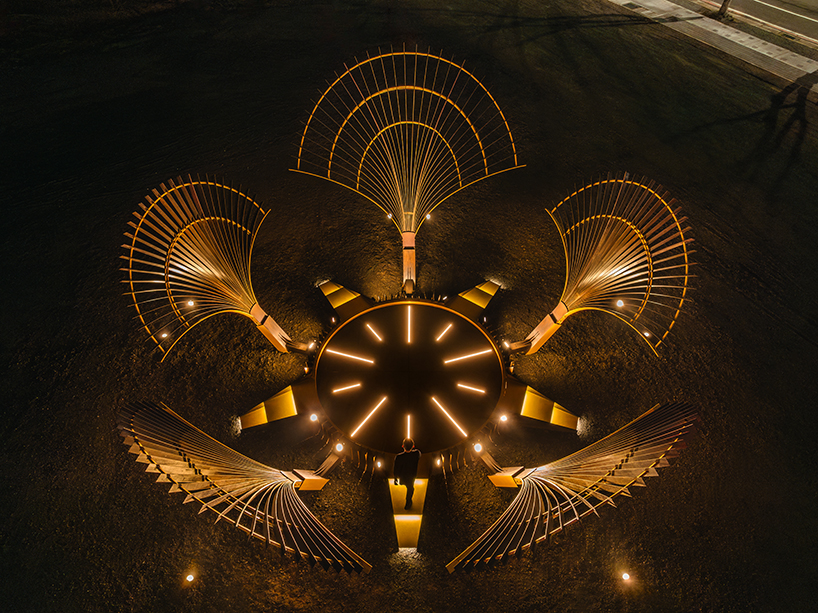
Temple: Flame Tree installation, designed for the Taiwan Lantern Festival
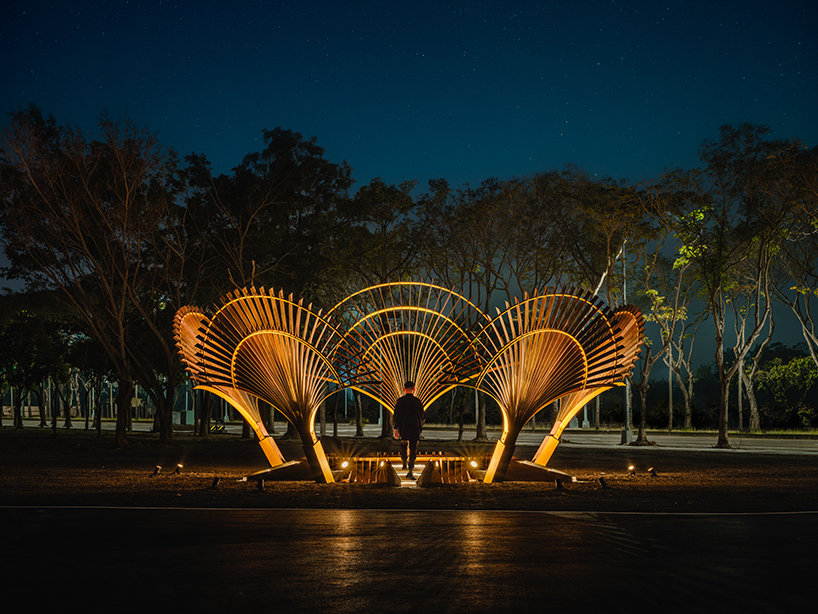
bent wooden planks form the fan-like structural components
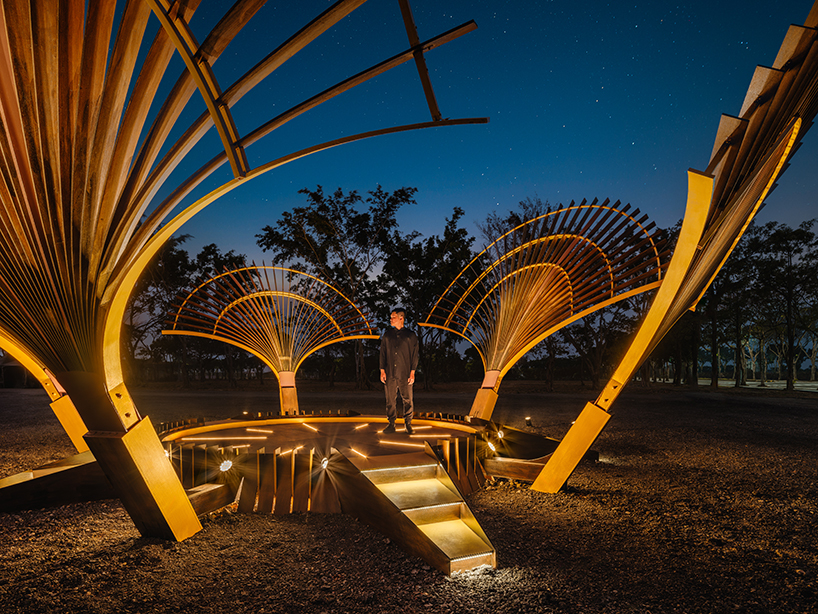
the pavilion draws inspiration from the royal poinciana’s branching canopy